
PHP2Shell: the attacks began four days before the patch
Amazon found the first PHP2Shell exploitation attempt on 17 October 2026, four days before disclosure. That changes the window your investigation must cover.
- by blacklens.io Team
- Published
- 5 min read
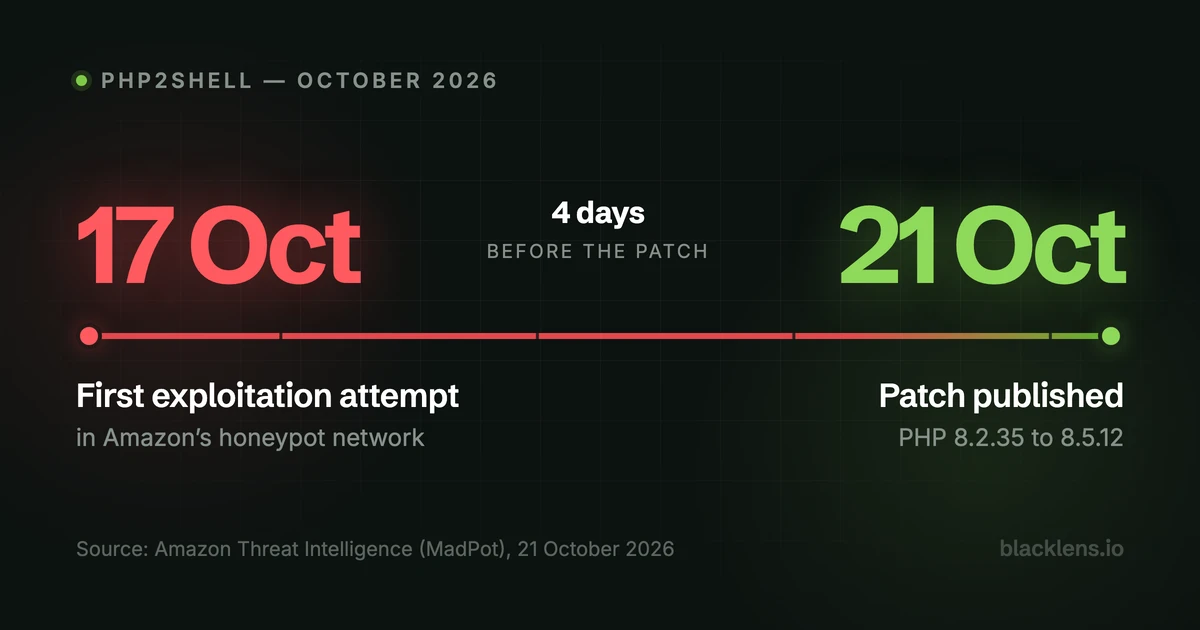
Four days before PHP disclosed the two flaws, the first exploitation attempt was running. Amazon Threat Intelligence found it in the telemetry of its MadPot honeypot network, dated 17 October 2026. Close PHP2Shell the moment the version number is right and you have checked four days too few.
What Amazon saw before disclosure
Amazon Threat Intelligence published on 21 October that the earliest PHP2Shell exploitation attempt in its MadPot telemetry dates to 17 October 2026 — four days before disclosure, three days before the leak. The request came from a commercial anonymisation network and hit a honeypot, which Amazon reads as a sign of a threat actor rather than research. How the actor obtained exploit information beforehand is unclear.
From 02:00 UTC on 21 October, twelve hours before the 14:00 UTC release, MadPot saw several proof-of-concept exploits from further anonymised infrastructure. Payloads and origins differed, which points to several independent actors; whether any would have worked against real systems is left open. CJ Moses, CISO of Amazon Integrated Security, sums up the state after the release: "PHP2Shell is now being broadly exploited in the wild." Mechanism, fixed versions and interim measures are in yesterday's post.
How exploits arrived before the patch
17 October remains unexplained. The twelve hours before the release do not. The PHP Foundation laid out that chain in its postmortem of 21 October:
| Time (UTC) | Event |
|---|---|
| 17 Oct | First exploitation attempt in Amazon's honeypot telemetry, source unknown |
| 20 Oct, 15:00 | CVE numbers circulate in forums, with the wrong release time and a wrong CVSS of 10.0 |
| 20 Oct, 20:00 | Calif accidentally publishes a video of its own exploit |
| 20 Oct, 23:00 | Mitigation guidance to critical infrastructure operators may have leaked as well |
| 21 Oct, 07:41 | Chainguard publishes container images carrying the fix, six hours early |
| 21 Oct, 14:00 | Coordinated release of advisories and fixed versions |
The Foundation objects not to the early fix but to its comparability: "Any attacker could now study the fix in binary form while every other PHP user was still waiting for the release." Chainguard CEO Dan Lorenc does not dispute the timing, but he does dispute the reading: "I made the call to get these out early when exploits hit in the wild." The Foundation's own security team had identified no functional public exploit by release time, and calls the delay since the first signs in 2024 "a structural failure".
Status on 22 October: millions of attempts, no confirmed breach
No successful break-in through PHP2Shell has been confirmed. The number of attempts has. Cloudflare CEO Matthew Prince reports thousands across his network in the ten hours before the announcement, tens of thousands in the 45 minutes after, hundreds of thousands within two hours and millions by now. Cloudflare also sees attackers varying payloads and reading which requests the web application firewall blocks.
Volume is not success. Jake Knott of watchTowr says none of the circulating proof-of-concepts achieves code execution: they fail, measure timing differences, or crash the target process. VulnCheck saw at least one address trying, unsuccessfully, to drop a web shell. Germany's BSI states in version 1.1 of its 21 October warning that no confirmed exploitation is known so far. Neither number appears in the CISA KEV catalogue as of 22 October. JFrog also found fake exploits and prank malware in public repositories — test that code against your own systems and you may be testing something other than the flaw.
What this means for your investigation
Amazon recommends starting the investigation window on 17 October, not on patch day. In practice the first step is preserving evidence before rotation deletes it: web server logs and the process and file state of every reachable PHP system from 16 October.
- Requests: POST requests carrying the string
PHP_SESSION_UPLOAD_PROGRESSinmultipart/form-databodies, plus clusters of HTTP 500 responses and crashed PHP workers. - Processes: any shell, interpreter or download tool started by
php-fpm,php-cgi,httpdorapache2, plus new files in the web root. - Detection without signatures: Amazon recommends detections that do not depend on CVE-specific signatures — first exploitation regularly precedes the first signature.
- Indicators: Amazon publishes six addresses from its telemetry. They belong to shared anonymisation infrastructure and are not exclusive to this activity: a reason to investigate, not a block list.
103.216.220.92     17.10.2026
31.223.184.166     21.10.2026
37.19.200.5        21.10.2026
134.209.159.64     21.10.2026
103.114.163.188    21.10.2026
95.217.98.37       21.10.2026
On the deadline such cases set, Amazon's driest sentence matters most: "A 7-day or 30-day SLA assumes a delay that no longer exists." The reason is structural and not limited to PHP: AI-assisted analysis makes it cheaper to turn a patch diff or an advisory into a working exploit.
What helps — and why visibility decides
A deadline measured in hours assumes the inventory exists when the advisory lands. Between 17 and 21 October it was the only usable information there was.
blacklens.io uses Attack Surface Management to track which services and web applications are reachable from outside and which technologies run on them; internal systems are covered by the Sentry Agent. The Threat Center matches new CVEs against that inventory and shows, per hit, the EPSS score, KEV membership, available exploits and whether the match rests on the exact version or only on the product. Hunting on the host itself is not part of that; logs and monitoring on the system cover it.
Frequently asked questions
- Yes, according to Amazon Threat Intelligence. The earliest exploitation attempt in the telemetry of its MadPot honeypot network dates to 17 October 2026, four days before PHP's advisory, and came from a commercial anonymisation network. How the actor obtained exploit information beforehand is unclear. Further proof-of-concept attempts followed from 02:00 UTC on 21 October, twelve hours before the release.
More articles
Fortinet hardening release: patching without an advisory
Fortinet shipped critical fixes for FortiOS, FortiManager and FortiAnalyzer on 22 October 2026. The advisories with CVE ids only follow on 10 November.
- 5 min read
PHP2Shell: the patches are out, the cause was something else
PHP released patches for two critical RCE flaws on 21 October 2026. The cause sits in the PHP core, not in session upload progress.
- 9 min read
REA: What AI reverse engineering finds in your applications
With REA, AI agents take apart apps, binaries and firmware without source code. Which keys, interfaces and flaws that exposes, and what helps.
- 4 min read
See your attack surface within 24 hours.
We set up your workspace and walk you through the first findings.
- 14 days free, all features
- No credit card required
- We walk you through your first findings