
REA: What AI reverse engineering finds in your applications
With REA, AI agents take apart apps, binaries and firmware without source code. Which keys, interfaces and flaws that exposes, and what helps.
- by blacklens.io Team
- Published
- 4 min read
Reverse engineering used to be specialist work: driving a disassembler, reading pseudocode, testing hypotheses, often for days. The open-source project REA (Reverse Engineer Anything) hands that work to AI agents, and in October 2026 it became one of the fastest-growing repositories on GitHub. Whatever ships inside an app, a desktop client or a firmware image was never secret, only expensive to read. That barrier is now falling.
What is REA?
REA (Reverse Engineer Anything) is an open-source MCP server that lets AI coding agents such as Claude Code, Codex, Cursor or Gemini CLI analyse software without access to its source code. The Model Context Protocol (MCP) is the interface an agent uses to call external tools. Through it, REA drives established tools such as Ghidra or IDA as well as its own parsers. According to the project documentation, it covers native binaries, JavaScript and Electron apps, .NET assemblies, Android apps, firmware images, websites and network captures. The agent decides what to examine; REA runs the tools and returns the evidence.
The project is MIT-licensed and distributed as the npm package rea-agents. According to the tracking service OSSInsight, as cited by Startup Fortune, its GitHub stars rose from under 10,000 to around 234,000 between 6 and 14 October 2026. The usage policy names security research, malware analysis and interoperability as its purpose and explicitly rules out unauthorised access. The tool itself is freely available, to defenders and attackers alike.
What attackers can read from your applications
Reverse engineering exposes what a vendor considers hidden in shipped code. For Electron and JavaScript apps REA lists modules, routes and source maps; for Android apps, the manifest and decompiled methods; for websites and network captures, the data in transit.
Embedded secrets have the most serious consequences. In 2022 Symantec found hard-coded AWS credentials in 1,859 Android and iOS apps. More than three-quarters of those apps contained valid tokens for private cloud services. Often the tokens came from shared libraries and SDKs rather than the vendors' own code. A study from June 2026 found exploitable credentials for AI services in the network traffic of 282 of 444 iOS apps examined. Three months after disclosure, 72% of them were still exploitable.
Four more findings come within reach of people without specialist skills once AI does the analysis:
- Hidden interfaces and hosts: every API endpoint an app calls is public, documented or not. Code often also points to test, staging or admin systems, extending the external attack surface with systems never meant for the public.
- Security logic in the client: role checks, feature flags and input validation that only run in the app can be read and bypassed. The attacker talks to the back end directly.
- Outdated components: binaries reveal embedded libraries and their versions; REA, for example, reads module versions from Go programs. Matching them against known CVEs is then routine.
- Intellectual property: REA itself advertises that you can have a feature from someone else's app investigated and rebuilt for your own project. Whatever edge sits in your code can now be copied faster.
Software you only operate becomes readable too
The same analysis applies to products you buy and run at the perimeter. Anyone who wants to exploit a fixed vulnerability has to understand what the update changed, and that analysis is reverse engineering. Mandiant measured an average of just five days between disclosure and first observed exploitation for 2023 (excluding outliers; 2018–19: 63 days). Every tool that makes the analysis cheaper squeezes that window further, much as AI-driven vulnerability discovery does on the zero-day side.
VPN gateways, firewalls and IoT devices are particularly exposed. They run closed firmware, and REA takes apart firmware images and native binaries. A hard-coded password or an outdated component in the firmware affects every device in that series that is reachable from the internet.
The project documentation itself states that decompilation and AI-assisted analysis may be incomplete or incorrect. For attackers that is a small price: one hit is enough.
What helps – and where blacklens.io comes in
Five measures work regardless of any product:
- No secrets in the client: keys belong on the server. Where the app needs access, use short-lived tokens with minimal rights, and rotate any key that has ever shipped.
- Trust nothing from the client: authorisation and validation always run on the server.
- Inventory your interfaces: treat every endpoint an app calls as public. Debug and staging systems are not reachable from the internet.
- Know your dependencies: keep a bill of materials (SBOM) for every library you ship, including third-party SDKs, and update promptly.
- Patch exposed systems faster: the window between update and exploit keeps shrinking.
Obfuscating the code raises the effort but replaces none of these measures.
blacklens.io shows which findings of such an analysis can actually be attacked from outside. Attack Surface Management continuously discovers domains, subdomains, IP addresses, services and web applications reachable from the internet. A staging host referenced in your app's code appears there as an asset as soon as it is reachable under your domains, not only once an attacker finds it. The early warning system in the Threat Center matches new CVEs in real time against the technologies and versions detected by fingerprinting, and checks matches with a verification scan where a verification template exists. With Penetration Testing as a Service, OSCP-certified pentesters test your web applications, APIs and infrastructure; findings appear as verified in the same platform, and retests are included in the pentest licence price.
Reverse engineering is becoming a standard capability. Plan as if your software were readable, because for far more people it now is.
Frequently asked questions
- REA (Reverse Engineer Anything) is an open-source MCP server under the MIT licence that lets AI coding agents such as Claude Code, Codex or Cursor analyse software without access to its source code. REA drives tools such as Ghidra or IDA alongside its own parsers and covers native binaries, Electron and JavaScript apps, .NET assemblies, Android apps, firmware and websites. It is distributed as the npm package rea-agents and was one of the fastest-growing repositories on GitHub in October 2026.
More articles
PHP2Shell: two critical PHP flaws, no patch for older versions
PHP2Shell: on 21 October 2026 PHP fixes two critical RCE flaws rated CVSS 9.2, but only for branches 8.2 to 8.5. What admins should do now.
- 5 min read

Citrix NetScaler: two zero-days, and patching alone is not enough
Two zero-days in Citrix NetScaler ADC and Gateway are under active exploitation: which builds are affected and what to do before and after updating.
- 4 min read
Threat Center: From CVE alarm to confirmed exposure
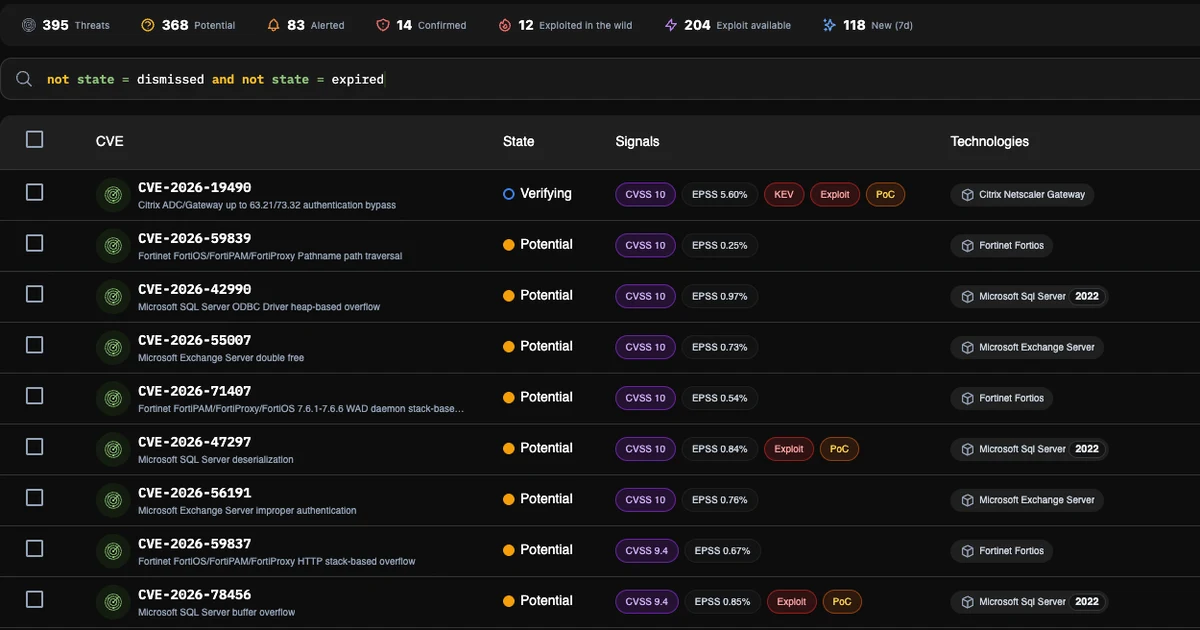
The blacklens.io Threat Center is your early warning system for new vulnerabilities: it shows which CVEs affect your systems and confirms it by scan.
- 3 min read
See your attack surface within 24 hours.
We set up your workspace and walk you through the first findings.
- 14 days free, all features
- No credit card required
- We walk you through your first findings